
What is an AI Support Chatbot with RAG? (Explained Simply)
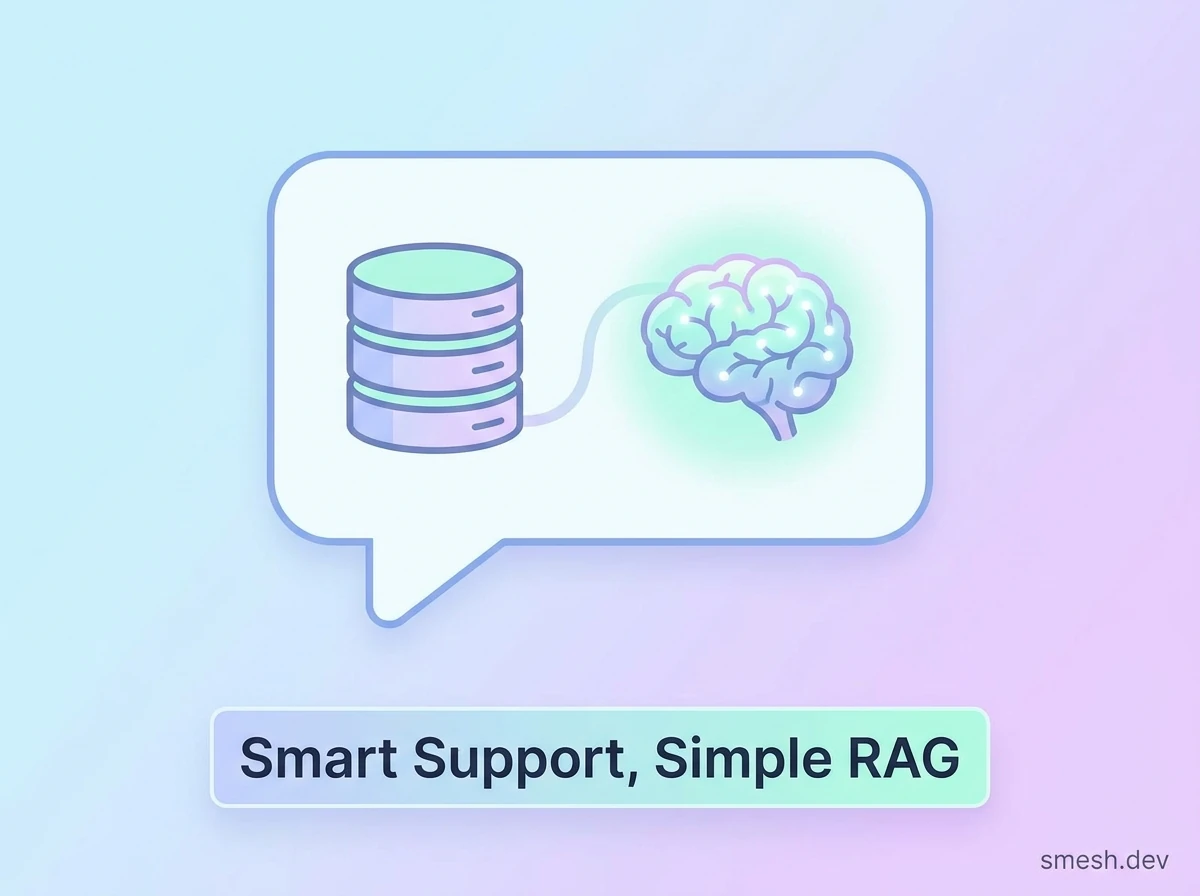
Customer support bottlenecks like delay, repetitive tickets, and manual errors drain startup budgets. Learn how Retrieval-Augmented Generation (RAG) powers AI support chatbots to answer customer queries accurately using your own files.
Imagine your customer support team is drowning.
Every single day, your inbox and WhatsApp channels are flooded with the exact same questions: “What is your refund policy?”, “How long does shipping take to Lahore?”, or “Where is my tracking link?”.
Your support agents spend hours copy-pasting the same replies. Customers get frustrated by 3-hour delays. Human errors creep in, leading to wrong shipping promises. Worst of all, while your team is busy answering repetitive tickets, high-value leads are slipping through the cracks.
You know AI can help. But standard AI chatbots (like ChatGPT) have a fatal flaw: they hallucinate. They invent fake discount codes, promise refunds that violate your terms, and know absolutely nothing about your specific business operations.
To solve this, modern businesses use Retrieval-Augmented Generation (RAG).
RAG is a developer-first architecture that connects a smart AI model to your own private business database. It ensures your chatbot answers queries accurately, safely, and strictly using your approved policies.
In this guide, we will break down what RAG is, how it works under the hood, and how you can implement it using n8n and Supabase to cut your support tickets by 50% and automate lead generation.
Zapier Assistants vs. Custom RAG (n8n + Supabase)
Many startup founders attempt to build AI bots using simple visual tools like Zapier or third-party wrappers. While easy to set up, these platforms present massive scalability bottlenecks:
| Feature | Zapier AI Assistants / Wrappers | Custom RAG (n8n + Supabase) |
|---|---|---|
| Data Ownership | Your business files are uploaded to closed third-party servers. | 100% Control: Files are stored securely inside your private Supabase database. |
| Execution Cost | Expensive monthly subscriptions and high per-inquiry fees. | Flat VPS hosting cost + cheap direct API tokens (saves up to 80%). |
| Search Customization | No control over vector search algorithms or thresholds. | Complete control over similarity thresholds and database queries. |
| CRM Integration | Hard to run multi-step actions (e.g. creating tickets, updating logs). | Natively integrates with any API, CRM, or custom database structure. |
For businesses looking to optimize operational costs and maintain data privacy, building a custom RAG engine using n8n and Supabase is the industry-standard choice.
What is RAG? (The Library Analogy)
To understand RAG, compare standard AI to a student taking a closed-book exam.
If you ask the student a question about your company's internal return policies, they have to guess. They will write a highly convincing, professional response that is entirely fabricated. This is an AI hallucination, and it is a major liability for businesses.
RAG turns the exam into an open-book test.
Instead of guessing, the AI is seated in a library containing all your company’s PDFs, manuals, and databases. When a customer asks a question, a search assistant (the retrieval engine) runs to the shelf, grabs the 3 most relevant pages, places them in front of the AI, and says: “Answer the customer using ONLY these pages. If the answer isn't here, say you don't know and connect them to a human.”
Caption: How Retrieval-Augmented Generation limits AI models to answering customer questions using verified business documents.
How RAG Works: A 3-Step Engineering Blueprint
Building a production-ready RAG system involves three sequential phases.
Step 1: Chunking and Vectorizing (The Preparation)
You cannot feed a 100-page operational manual to an LLM for every single customer message; it would be too slow and expensive.
Instead, we take your documentation and break it into small, readable text blocks (called "chunks") of 150-200 words. We pass these chunks through an embedding model (like OpenAI's text-embedding-3-small) which converts the text into mathematical coordinate lists called vectors. These vectors are stored in a database like Supabase.
The n8n Text Chunking Helper
Use this JavaScript snippet inside an n8n Code node to split large documents into clean, overlapping paragraphs before generating embeddings:
// Split incoming document text into chunks with 20-word overlaps
const items = input.all();
const chunkSize = 150; // target words per chunk
const overlap = 20;    // overlap words to preserve context

return items.flatMap(item => {
  const text = item.json.content || '';
  const words = text.trim().split(/\s+/);
  const chunks = [];

  for (let i = 0; i < words.length; i += (chunkSize - overlap)) {
    const chunkWords = words.slice(i, i + chunkSize);
    if (chunkWords.length > 10) {
      chunks.push({
        json: {
          document_id: item.json.id,
          chunk_content: chunkWords.join(' '),
          word_count: chunkWords.length
        }
      });
    }
    if (i + chunkSize >= words.length) break;
  }
  return chunks;
});
Step 2: Semantic Retrieval (The Search)
When a client sends a message (e.g., “Do you offer custom n8n setup services?”), n8n converts that query into a vector coordinate. It then performs a similarity search (using cosine distance) against your stored database chunks. Supabase instantly returns the paragraphs that are mathematically closest to the client's question.
Step 3: Contextual Generation (The Answer)
n8n packages the customer query and the retrieved database paragraphs into a single prompt, routing it to the LLM (like Gemini or GPT-4o). The system instructs the model to generate a natural, friendly reply using only the provided facts.
Why RAG is Your Strongest Client Acquisition Funnel
A customer support chatbot should not just answer questions; it should act as a silent sales representative.
If a prospect asks, “How much do your services cost?” or “Can you build an n8n lead router for my agency?”, a RAG chatbot is trained to:
- Provide a helpful, clear answer based on your pricing sheet or case studies.
- Link directly to your specialized service page (e.g. your Workflow Automation Service page).
- Recognize the commercial intent, prompt the user for their company email or phone number, and automatically create a lead record in your Supabase CRM.
- Ping your internal team on Slack via n8n: “High-intent lead captured from chat. Tap here to view the chat history.”
By turning support chats into structured leads, you transform an operational cost center into a customer generation engine. Learn how we configure these omnichannel flows: WhatsApp Automation Service.
Setting Up pgvector on Supabase: Production Database Schema
To build your own RAG engine, execute the following SQL script inside your Supabase SQL Editor. This schema creates the necessary storage tables, indexes, and search functions:
-- Enable vector search inside Supabase
create extension if not exists vector with schema extensions;

-- Table to store document chunks
create table public.kb_chunks (
    id uuid primary key default gen_random_uuid(),
    document_title text not null,
    chunk_content text not null,
    embedding vector(1536), -- Matches OpenAI embedding dimensions
    metadata jsonb default '{}'::jsonb,
    created_at timestamptz default now()
);

-- Apply an HNSW index to enable sub-10ms vector lookups
create index kb_chunks_embedding_idx
on public.kb_chunks
using hnsw (embedding vector_cosine_ops);

-- RPC Function for similarity search
create or replace function public.match_kb_chunks (
  query_embedding vector(1536),
  match_count int default 3,
  similarity_threshold float default 0.7
)
returns table (
  id uuid,
  document_title text,
  chunk_content text,
  similarity float
)
language sql stable
as $$
  select
    id,
    document_title,
    chunk_content,
    1 - (embedding <=> query_embedding) as similarity
  from public.kb_chunks
  where 1 - (embedding <=> query_embedding) > similarity_threshold
  order by embedding <=> query_embedding
  limit match_count;
$$;
Once this schema is set up, your n8n workflow can query the database using a simple RPC call node, retrieving precise context chunks in milliseconds. See how we design dashboards to monitor these systems: Dashboards & Internal Tools Service.
Action Plan: Build Your AI Support Ecosystem
To build a production-ready AI chatbot, follow this implementation path:
- Audit Your Support Logs: List the top 20 questions your team answers manually every day.
- Centralize Your Data: Compile your return policies, onboarding guides, and pricing sheets into clean, plain-text documents.
- Deploy a Resilient Database: Set up Supabase with
pgvectorto act as your long-term memory. - Wire the n8n Workflow: Configure webhooks to ingest chat messages (via Gmail, Webflow, or WhatsApp Business Cloud API), run similarity searches, and prompt the LLM to write responses.
- Build a Human Safety Gate: Set up fallback triggers so that if the chatbot's answer confidence falls below a threshold, the conversation is routed immediately to a human.
Developing an automated RAG chatbot requires professional execution, but it pays dividends immediately. If you want to jumpstart your setup, download our n8n Lead Router Workflow Template or explore our AI Support Chatbots Service page.
Frequently Asked Questions
What happens if a customer asks a question that is not in my support documents?
A well-designed RAG chatbot will not guess or hallucinate. In your system prompt, instruct the model: 'If the retrieved context does not contain the answer, reply: "I'm sorry, I don't have that information. Let me connect you with a team member."'. n8n will catch this response, create a lead record in Supabase, and dispatch a notification to your team on Slack.
Does updating my pricing or return policy require retraining the AI chatbot?
No. This is the biggest advantage of RAG. Because the AI model is not retrained, you simply update the text files or rows in your Supabase database. The next time a customer asks a question, the vector search retrieves the new pricing text instantly, and the bot responds with the updated details.
How do I prevent my chatbot from being manipulated by prompt injection attacks?
Implement input validation guardrails. Run incoming messages through a lightweight classification model (like GPT-4o-mini or Llama 3) to scan for system override commands (e.g., 'ignore previous instructions'). Additionally, enforce strict system templates that separate user variables from system instructions using structural delimiters.
Is pgvector on Supabase fast enough for enterprise-scale RAG search?
Yes. By applying an HNSW (Hierarchical Navigable Small World) index to your embedding column, Supabase can run similarity searches across millions of rows in sub-10ms. This is faster and more cost-effective than using dedicated vector databases like Pinecone or Milvus.
What is the token cost difference between running a RAG chatbot vs a standard chatbot?
While RAG sends more input tokens (since it attaches relevant document context to every prompt), it is highly cost-effective because it prevents errors, eliminates manual agent salaries, and allows you to use cheaper balanced models (like Terra or Llama 3) instead of flagship reasoning models for basic inquiries.
Summary wrap-up
Automating operational workflows using custom-mapped n8n instances and centralizing logs inside Supabase is the single highest-leverage move for service operations today. It eliminates overhead and ensures zero customer inquiries slip through the cracks.

About the Author: Haider Ali Verified Specialist
Principal Automation Engineer & Founder at Smesh.dev
Haider Ali is an expert automation engineer specializing in building custom n8n pipelines, designing relational Supabase databases, training RAG-powered support chatbots, and building high-speed static websites for businesses across Pakistan and internationally.
Related Blueprints & Guides
Ready to implement this system?
Skip the manual headaches. Schedule a free 15-minute discovery audit call and let's map out the shortest automation path for your workflows.